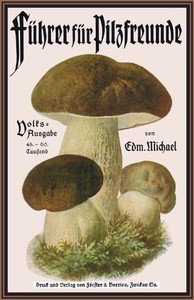
Führer für Pilzfreunde by Edmund Michael

(5 User reviews)   374
By Ashley Johnson Posted on Jan 12, 2026
In Category - Gardening
Michael, Edmund, 1849-1920 Michael, Edmund, 1849-1920
German
Hey, have you ever looked at a mushroom in the woods and wondered, 'Can I eat that, or will it send me on a one-way trip to the hospital?' That's the exact question Edmund Michael's old guidebook tackles. Forget modern apps—this is a time capsule from over a century ago, written when foraging wasn't a hobby but a serious survival skill. It's less of a dry field guide and more a passionate plea from a man who desperately wanted people to appreciate fungi without accidentally poisoning themselves. The real mystery isn't in the plot, but in seeing how our relationship with nature—and our basic need to know what's safe to eat—hasn't really changed all that much.
Share

Read "Führer für Pilzfreunde by Edmund Michael" Online

This book is available in the public domain. Start reading the digital edition below.

START READING FULL BOOK
Instant Access    Mobile Friendly

Book Preview

A short preview of the book’s content is shown below to give you an idea of its style and themes.

coastlines, excluding inland water bodies (lakes, reservoirs, rivers). Comparative areas are based on total area equivalents. Most entities are compared with the entire US or one of the 50 states. The smaller entities are compared with Washington, DC (178 sq km, 69 sq mi) or The Mall in Washington, DC (0.59 sq km, 0.23 sq mi, 146 acres). Birth rate: The average annual number of births during a year per 1,000 population at midyear; also known as crude birth rate. Dates of information: In general, information available as of 1 January 1995 is used in the preparation of this edition. Population figures are estimates for 1 July 1995, with population growth rates estimated for calendar year 1995. Major political events have been updated through April 1995. Death rate: The average annual number of deaths during a year per l,000 population at midyear; also known as crude death rate. Digraphs: The digraph is a two-letter "country code" that precisely identifies every entity without overlap, duplication, or omission. AF, for example, is the digraph for Afghanistan. It is a standardized geopolitical data element promulgated in the Federal Information Processing Standards Publication (FIPS) 10-3 by the National Bureau of Standards (now called National Institute of Standards and Technology) at the US Department of Commerce and maintained by the Office of the Geographer at the US Department of State. The digraph is used to eliminate confusion and incompatibility in the collection, processing, and dissemination of area-specific data and is particularly useful for interchanging data between databases. Diplomatic representation: The US Government has diplomatic relations with 184 nations, including 178 of the 185 UN members (excluded UN members are Bhutan, Cuba, Iran, Iraq, North Korea, former Yugoslavia, and the US itself). In addition, the US has diplomatic relations with 6 nations that are not in the UN - Holy See, Kiribati, Nauru, Switzerland, Tonga, and Tuvalu. Economic aid: This entry refers to bilateral commitments of official development assistance (ODA) and other official flows (OOF). ODA is defined as financial assistance which is concessional in character, has the main objective to promote economic development and welfare of LDCs, and contains a grant element of at least 25%. OOF transactions are also official government assistance, but with a main objective other than development and with a grant element less than 25%. OOF transactions include official export credits (such as Ex-Im Bank credits), official equity and portfolio investment, and debt reorganization by the official sector that does not meet concessional terms. Aid is considered to have been committed when agreements are initialed by the parties involved and constitute a formal declaration of intent. Entities: Some of the nations, dependent areas, areas of special sovereignty, and governments included in this publication are not independent, and others are not officially recognized by the US Government. "Nation" refers to a people politically organized into a sovereign state with a definite territory. "Dependent area" refers to a broad category of political entities that are associated in some way with a nation. Names used for page headings are usually the short-form names as approved by the US Board on Geographic Names. There are 266 entities in The World Factbook that may be categorized as follows: NATIONS 184 -- UN members (excluding the former Yugoslavia, which is still counted by the UN) 7 -- nations that are not members of the UN--Holy See, Kiribati, Nauru, Serbia and Montenegro, Switzerland, Tonga, Tuvalu OTHER 1 -- Taiwan DEPENDENT AREAS 6 -- Australia--Ashmore and Cartier Islands, Christmas Island, Cocos (Keeling) Islands, Coral Sea Islands, Heard Island and McDonald Islands, Norfolk Island 2 -- Denmark--Faroe Islands, Greenland 16...

This is a limited preview. Download the book to read the full content.

Published in the early 1900s, Führer für Pilzfreunde (Guide for Mushroom Friends) is exactly what it says on the tin. This isn't a novel with characters; the main "character" is the mushroom itself. Edmund Michael, a dedicated mycologist, systematically describes hundreds of fungi found in German-speaking Europe. He details their appearance, habitats, and—most crucially—which ones are edible, which are inedible, and which are downright deadly.

The Story

The "story" here is one of careful observation and clear instruction. Michael walks you through the forest floor, pointing out the distinguishing features of each species. He uses the scientific knowledge of his time to separate look-alikes, like the prized chanterelle from its toxic false counterpart. The entire book builds toward a single, vital goal: giving everyday people the confidence to forage safely and appreciate the incredible diversity right under their feet.

Why You Should Read It

Reading this today is a fascinating experience. You're not just learning about mushrooms; you're getting a direct line to how people interacted with nature over 100 years ago. Michael's passion is obvious—he wasn't just a scientist in a lab, but someone who wanted to share his wonder. It makes you slow down and really look at the details, something we often forget to do. It’s a humble reminder of a time before instant digital answers, when knowledge was painstakingly compiled in books like this one.

Final Verdict

This is a niche but wonderful read for history of science enthusiasts, foraging hobbyists curious about the origins of their craft, or anyone who loves old books with a practical soul. It's not a modern field guide (please don't use it as one!), but as a historical document, it’s a quiet, profound look at a man’s mission to make the natural world a little safer and a lot more interesting for everyone.


📜 Community Domain

No rights are reserved for this publication. Use this text in your own projects freely.

Donna White
4 months ago

I discovered this unexpectedly and the content flows smoothly from one chapter to the next. A perfect companion for a quiet weekend.

Thomas Anderson
5 months ago

Without a doubt, the material feels polished and professionally edited. I appreciate the effort put into this.

John Campbell
1 month ago

I had low expectations initially, however it creates a vivid world that you simply do not want to leave. Thanks for making this available.

Oliver Jackson
2 months ago

For a digital edition, the attention to historical detail adds a layer of realism that is rare. Absolutely essential reading.

Steven Lopez
2 months ago

As someone who reads a lot, the style is confident yet approachable. Highly recommended for everyone.

4.5
4.5 out of 5 (5 User reviews )

Add a Review

Your Rating *
There are no comments for this eBook.
You must log in to post a comment.
Log in

Related eBooks