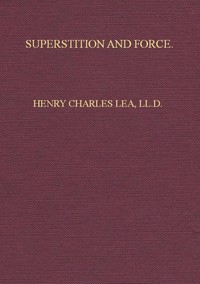
Superstition and Force by Henry Charles Lea

(4 User reviews)   705
By Ashley Johnson Posted on Jan 12, 2026
In Category - Gardening
Lea, Henry Charles, 1825-1909 Lea, Henry Charles, 1825-1909
English
Ever wondered why we swear on a Bible in court? Or why we say 'cross my heart'? This book explains how those little rituals are leftovers from a wild time when people used superstition as law. Henry Charles Lea shows us how, for centuries, people didn't just ask for evidence—they asked for miracles. Guilt was decided by who could hold a red-hot iron without getting burned, or who could survive being thrown in a lake. It's a fascinating look at the strange, often brutal, intersection of belief and justice, and a reminder of how far we've come (and how much of that old magic still lingers in our systems).
Share

Read "Superstition and Force by Henry Charles Lea" Online

This book is available in the public domain. Start reading the digital edition below.

START READING FULL BOOK
Instant Access    Mobile Friendly

Book Preview

A short preview of the book’s content is shown below to give you an idea of its style and themes.

Plurima est et in omni jure civili, et in pontificum libris, et in XII. tabulis, antiquitatis effigies.—CICERO, _de Oratore I._ 43. Fourth Edition, Revised. Philadelphia: Lea Brothers & Co. 1892. Entered according to Act of Congress in the year 1892, by Henry C. Lea, in the Office of the Librarian of Congress. All rights reserved. Collins Printing House. PREFACE. The history of jurisprudence is the history of civilization. The labors of the lawgiver embody not only the manners and customs of his time, but also its innermost thoughts and beliefs, laid bare for our examination with a frankness that admits of no concealment. These afford the surest outlines for a trustworthy picture of the past, of which the details are supplied by the records of the chronicler. It is from these sources that I have attempted, in the present work, a brief investigation into the group of laws and customs through which our forefathers sought to discover hidden truth when disputed between man and man. Not only do these throw light upon the progress of human development from primitive savagism to civilized enlightenment, but they bring into view some of the strangest mysteries of the human mind. In this edition I have endeavored to indicate, more clearly than before, the source, in prehistoric antiquity, of some of the superstitions which are only even now slowly dying out among us, and which ever and anon reassert themselves under the thin varnish of our modern rationalism. In a greatly condensed form the first three essays originally appeared in the North American Review. June, 1878. * * * * * Although in the revision of this volume for a fourth edition there has not been found much to alter, considerable additions have been made which render the survey of the subject more complete. In revising the essays on the Wager of Battle and the Ordeal I have had the advantage of the labors of two recent writers, Dr. Patetta, whose “Le Ordalie” is an extended and philosophical investigation into the whole topic of the Judgments of God, and George Neilson, Esq., whose “Trial by Combat” is a complete account, from the original sources, of the history of the judicial duel in Great Britain. Mr. Neilson has also had the courtesy to communicate to me the results of his further studies of the subject. I therefore indulge the hope that the present edition will be found more worthy of the favor with which the work has been received. PHILADELPHIA, October, 1892. CONTENTS. I. THE WAGER OF LAW. CHAPTER I. RESPONSIBILITY OF THE KINDRED. PAGE Crime originally an offence against individuals 13 Tribal organization—Responsibility of kindred 14 Compensation for injuries—The _Wer-gild_ 17 CHAPTER II. THE OATH AND ITS ACCESSORIES. Perplexities as to evidence 21 Guarantees required for the oath 25 CHAPTER III. CONJURATORS, OR PARTAKERS IN THE OATH. The Wager of Law a prehistoric Aryan custom 33 It is adopted by the Church 35 CHAPTER IV. SELECTION OF COMPURGATORS. They are originally the kindred 38 Strangers admitted 41 Numbers required 43 Modes of selection 47 CHAPTER V. CONDITIONS OF COMPURGATION. Employed in default of testimony 52 Except in Wales 54 Dependent on importance of case 56 As an alternative for the Wager of Battle 57 CHAPTER VI. FORMULAS AND PROCEDURE. Forms of compurgatorial oath 58 Modes of administration 60 Qualified confidence reposed in Compurgation 61 Conjurators liable to penalties of perjury 63 CHAPTER VII. DECLINE OF COMPURGATION. Early efforts to limit or abolish it 67 The oath no longer a positive asseveration 71 Influence of revival of Roman law 73 Conservatism of Feudalism 76 Gradual...

This is a limited preview. Download the book to read the full content.

Henry Charles Lea's Superstition and Force isn't a story about one person. It's the story of an idea: how societies, especially in medieval Europe, tried to figure out who was telling the truth. Forget detectives and DNA. For a long time, the legal system relied on 'ordeals' and 'oaths' that were basically supernatural tests.

The Story

The book walks us through these bizarre practices. Imagine a murder trial where the suspect has to grab a red-hot piece of metal. If their hand heals cleanly in three days, God has declared them innocent. Or, if you're accused of something, you might be tied up and tossed in a lake—if you float, you're guilty (because the water, a pure element, rejects you). Lea traces how these rituals, rooted in pagan and early Christian beliefs, became formal court procedures. He then shows how the church and growing legal reasoning slowly pushed them out, replacing 'trials by ordeal' with things like jury trials. It's the messy, centuries-long plot of reason slowly wrestling superstition to the ground.

Why You Should Read It

This book makes you look at everyday things differently. When you hear 'beyond a reasonable doubt,' you'll think about its opposite: 'prove it by surviving this fire.' Lea connects the dots in a way that's both shocking and logical. You see how people used the tools they had—a deep belief in divine intervention—to solve real-world problems. It’s not a dry list of facts; it reads like a collection of the strangest court cases you can imagine, all of which really happened.

Final Verdict

Perfect for anyone who loves history, true crime, or legal dramas, but wants to see the origin story. If you enjoy podcasts or shows that explore the 'why' behind our modern traditions, this is your book. It's for the curious reader who doesn't mind older writing (it was published in 1866) and wants a deep, rewarding look at one of the weirdest chapters in human history. You'll never take a sworn oath for granted again.


📜 Legacy Content

The copyright for this book has expired, making it public property. It is now common property for all to enjoy.

Thomas Torres
4 months ago

Compared to other books on this topic, the content encourages further exploration of the subject. It is definitely a 5-star read from me.

Joseph Lewis
4 months ago

I didn’t think I would enjoy this, but the attention to historical detail adds a layer of realism that is rare. It exceeded all my expectations.

Melissa Roberts
4 months ago

Once I started reading, the insights offered are both practical and thought-provoking. I have no regrets downloading this.

Edward Carter
3 months ago

From a casual reader’s perspective, the plot twists are genuinely surprising without feeling cheap or forced. Time very well spent.

4.5
4.5 out of 5 (4 User reviews )

Add a Review

Your Rating *
There are no comments for this eBook.
You must log in to post a comment.
Log in

Related eBooks