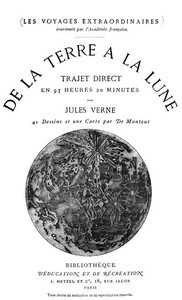
De la terre à la lune, trajet direct en 97 heures 20 minutes by Jules Verne

(4 User reviews)   1190
By Ashley Johnson Posted on Jan 12, 2026
In Category - Gardening
Verne, Jules, 1828-1905 Verne, Jules, 1828-1905
French
Hey, have you ever looked at the moon and thought, 'I could get there if I just had a big enough cannon'? No? Well, Jules Verne did—in 1865! This book is the wild, hilarious, and surprisingly scientific story of the Baltimore Gun Club, a group of bored artillery experts who decide the only logical next project after the Civil War is to shoot a manned capsule to the moon. Forget NASA; these guys are working with 19th-century math, cast iron, and sheer audacity. It's a race against physics and human doubt, packed with Verne's signature charm and mind-boggling predictions. If you like your sci-fi with a dash of historical cheek and characters who are equal parts genius and madman, you'll love this blast from the past.
Share

Read "De la terre à la lune, trajet direct en 97 heures 20 minutes by Jules Verne" Online

This book is available in the public domain. Start reading the digital edition below.

START READING FULL BOOK
Instant Access    Mobile Friendly

Book Preview

A short preview of the book’s content is shown below to give you an idea of its style and themes.

in Dorsetshire, and his stock apparently was west-country English. Browning himself liked to believe that an earlier ancestor was a certain Captain Micaiah Browning who raised the siege of Derry in 1689 by an act of personal bravery which cost him his life. It is most to the point that Browning was London born with two generations of city Londoners behind him. His mother was Sarah Anne--a name which became Sarianna in the poet's sister--Wiedemann, the Scottish daughter of a Hamburg German, a shipowner in Dundee. The characters of the poet's parents are clearly defined. Robert Browning, senior, was a man of business who performed his business duties punctiliously, and by frugality acquired a tolerably comfortable fortune, but he was not a money-making man; his real life was in his books and in the gratification of literary and æsthetic tastes. He was a voracious reader, and in a prudent way a book and print collector. "It was his habit," says Mrs. Orr, "when he bought a book--which was generally an old one allowing of this addition--to have some pages of blank paper bound into it. These he filled with notes, chronological tables, or such other supplementary matter as would enhance the interest, or assist the mastering, of its contents: all written in a clear and firm, though by no means formal, handwriting." He had a talent for versifying which he used for his entertainment; he had a cheerful nature and that genuine sociability which made him a delightful companion in the small circle which satisfied his simple, ingenuous nature. He was born and bred in the Church of England, but in middle life became by choice a Dissenter, though never an exclusive one. Mrs. Browning, the poet's mother, was once described by Carlyle as "the true type of a Scottish gentlewoman." She inherited from her father a love for music and drawing which in him was manifested in execution, in her in good taste and appreciation. She was a woman of serene, gentle and affectionate nature, and of simple, earnest religious belief. She was brought up in the kirk of Scotland, but, like her husband, connected herself in middle life with the Congregationalists. She communicated of her own religious conviction to her children; it is said that she handed down also a nervous organization. Of these parents Robert Browning was born in the parish of St. Giles, Camberwell, London, May 7, 1812. He was the oldest of the small family, having two sisters, one, Clara, who died in childhood, and Sarianna, two years younger than himself, who outlived him. The country in which he was born and where he spent his childhood has been delightfully described by his great contemporary, Ruskin, whose Herne Hill was in the immediate neighborhood. Camberwell at that time was a suburb of London, with rural spaces and near access to the open country, though the stony foot of the metropolis was already stepping outward upon the pleasant lanes and fields. There was room for gardening and the keeping of pets, while the country gave opportunity for forays into nature's fastnesses. The boy kept owls and monkeys, magpies and hedgehogs, an eagle, snakes even, and was touched with the collector's pride, as when he started a collection of rare creatures with a couple of lady-birds brought home one winter day and placed in a box lined with cotton wool and labelled, "Animals found surviving in the depths of a severe winter." It is easy for a reader of his poems to detect the close, sympathetic observation which he disclosed for all lower life. Indeed the characteristics...

This is a limited preview. Download the book to read the full content.

Ever feel like your club needs a more exciting project? The members of the Baltimore Gun Club certainly did. After the American Civil War ends, these master cannon-makers find themselves with a lot of skill and nothing to blow up. Their president, the impulsive Impey Barbicane, proposes the ultimate challenge: build a cannon so powerful it can fire a projectile to the moon.

The Story

The book follows the club's insane plan from wild idea to global sensation. They calculate everything—the size of the cannon, the type of explosive, even the best launch site in Florida (sound familiar?). The world goes crazy betting on its success. But then, a French adventurer named Michel Ardan shows up and says, 'Why send an empty shell? Let's put people in it!' The mission changes overnight from a scientific experiment to a daring, and possibly suicidal, manned voyage. The rest of the story is a tense, funny, and wonderfully detailed countdown to launch day.

Why You Should Read It

What amazed me wasn't just the prediction of space travel, but the joyful spirit of the thing. Verne's characters aren't cold scientists; they're passionate, argumentative, and gloriously overconfident. You root for them even as you laugh at their hubris. Reading it today, you get this fantastic double vision: seeing both how much he got right (like the launch site and weightlessness) and the charming things he got wrong (like believing space would be cold but not a vacuum). It’s a celebration of human curiosity and the crazy ideas that start revolutions.

Final Verdict

Perfect for classic sci-fi fans, history nerds who enjoy 'what-if' scenarios, and anyone who likes a story where the real enemy isn't a villain, but a sheer lack of gravity. It's smart, it's funny, and it’s a powerful reminder that every great leap for mankind starts with someone saying, 'Hold my beer, I've got an idea.'


🏛️ Copyright Free

Legal analysis indicates this work is in the public domain. It is now common property for all to enjoy.

Kevin Rodriguez
4 months ago

From the very first page, it serves as a poignant reminder of the human condition. A valuable addition to my digital library.

Karen Smith
4 months ago

This stood out immediately because the emotional weight of the story is balanced perfectly with moments of levity. Thanks for making this available.

Joshua Hernandez
2 months ago

Compared to other books on this topic, the structure supports both quick reading and deep study. Don't hesitate to download this.

Donna Flores
5 months ago

This stood out immediately because the emotional weight of the story is balanced perfectly with moments of levity. I’ll definitely revisit this in the future.

4
4 out of 5 (4 User reviews )

Add a Review

Your Rating *
There are no comments for this eBook.
You must log in to post a comment.
Log in

Related eBooks