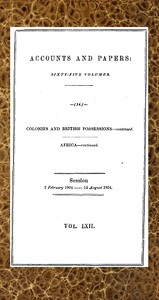
Correspondence and Report from His Majesty's Consul at Boma Respecting the…

(4 User reviews)   941
By Ashley Johnson Posted on Jan 12, 2026
In Category - Gardening
Casement, Roger, 1864-1916 Casement, Roger, 1864-1916
English
Okay, I just read something that will stick with me. It's not a novel; it's a real, official government report from 1904. But it reads like a detective story—a horrifying one. A British diplomat, Roger Casement, goes deep into the Congo Free State, which is run as the personal property of King Leopold II of Belgium. He's supposed to check on trade conditions. What he finds instead is a system of slavery and terror so brutal it will make you put the book down just to breathe. This is the document that helped change history. It's tough, but it's important.
Share

Read "Correspondence and Report from His Majesty's Consul at Boma Respecting the…" Online

This book is available in the public domain. Start reading the digital edition below.

START READING FULL BOOK
Instant Access    Mobile Friendly

Book Preview

A short preview of the book’s content is shown below to give you an idea of its style and themes.

No. | Name. | Date. | SUBJECT. | Page. ----+-------------------+-------------+--------------------------------+------ 1 | Lord Cromer |Jan. 21, 1903|Visit to Congo stations of Kiro | | | | and Lado. Native | | | | relations with Congo officials.| | | | Few natives, to be | | | | seen in the stations | 1 | | | | 2 | Sir C. Phipps |Sept. 19, |Transmits note from Congo | | | | Government in answer | | | | to despatch of 8th August | | | | to Powers parties to | | | | the Act of Berlin | 2 | | | | 3 | Mr. Casement |Dec. 11, |Transmits report on his visit | | | | to interior of Congo | | | | State and on condition | | | | of natives | 21 | | | | 4 | To Sir C. Phipps |Feb. 11, 1904|Transmits Memorandum | | | | in answer to note of Congo | | | | Government of 12th | | | | September inclosed in No. 2 | 82 | | | | 5 | To His Majesty’s |Feb. 12, |Transmits papers on condition | | Representatives | | of affairs in Congo State | | at Paris | | State | | and other Capitals| | | 84 ----+-------------------+-------------+--------------------------------+------ Correspondence and Report from His Majesty’s Consul at Boma respecting the Administration of the Independent State of the Congo. No. 1. _The Earl of Cromer to the Marquess of Lansdowne_.--(_Received February 9_.) (Extract.) _On the Nile, near Kiro, January 21, 1903_ I have just visited the Belgian stations of Kiro and Lado, as also the station of Gondokoro in the Uganda Protectorate. Your Lordship may like to receive some remarks on the impressions I derived as regards the Belgian positions on the Upper Nile. I should, in the first instance, observe that Commandant Hanolet, who is in charge of the district, was absent in the interior of the country; but Sir Reginald Wingate and myself were most courteously received by the officers in command at Kiro and Lado. From the point of view of appearance, the two Belgian stations contrast favourably with any of the Soudanese stations on the Nile, and still more favourably with Gondokoro in the Uganda Protectorate. The principal dwelling-houses are of brick. They seem to be well built. The stations are kept scrupulously clean. The troops are well housed. Flourishing gardens have been created. I counted the graves of nine Europeans at Kiro, all of whom died of fever, but I am informed that the health of the place is now greatly improved. I had heard so many and such contradictory accounts of the Belgian Administration that I was very desirous of ascertaining some concise and definite evidence on this subject. During a hurried visit, and with opportunities of observation confined to the banks of the river, I scarcely anticipated that I should be able to arrive at any independent opinion on the point at issue. I saw and heard, however, quite enough to gain an insight into the spirit which pervades the Administration. It must be remembered that the 1,100 miles of country which I traversed between Khartoum and Gondokoro has, until recently, been the prey of slave-dealers, Egyptian Pashas, and dervishes. Under the circumstances, it might well have been expected that much time would be required to inspire confidence in the intentions of the new Government. It is, however, certain that, with the exception of a portion of the Nuer tribe, who live in a very remote region on...

This is a limited preview. Download the book to read the full content.

This isn't a book with a traditional plot. It's a piece of history—the official findings of an investigation. In 1903, Roger Casement, a respected British consul, was sent to the Congo Free State. His job was to write a report on life and trade there. What he discovered was a nightmare hidden behind the claim of a 'civilizing mission.'

The Story

Casement traveled up the Congo River, interviewing rubber plantation workers, village chiefs, and missionaries. His report is a collection of their testimonies. He details a system where men were forced to collect impossible quotas of wild rubber. If they failed, their villages were burned, women were held hostage, and people were brutally beaten or killed. The hands of the dead were often collected as proof for the colonial militia. Casement methodically lays out the evidence, naming places, dates, and perpetrators, building an undeniable case against the regime of King Leopold II.

Why You Should Read It

You read this for the raw power of truth. It's chilling because it's so matter-of-fact. Casement doesn't need to use flowery language; the simple statements from witnesses are devastating. It shows how one person's courage and careful work can expose a massive injustice. This report was a bombshell. It fueled an international protest movement and helped end Leopold's personal rule over the Congo. It's a dark chapter, but seeing how the truth came to light is compelling.

Final Verdict

This is for readers interested in real-world history, human rights, and the power of journalism. It's not an easy read—it's emotionally heavy. But if you've ever read a novel about colonial Africa and wondered about the real facts behind the fiction, this is the essential source document. Think of it as the foundation for books like King Leopold's Ghost. A difficult, necessary piece of writing.


ℹ️ Public Domain Content

This title is part of the public domain archive. Knowledge should be free and accessible.

Carol Carter
2 months ago

I was pleasantly surprised because the depth of research presented here is truly commendable. This turned out to be a great decision.

Kimberly Lopez
5 months ago

I didn't expect much, but the interplay between the protagonists drives the story forward beautifully. Time very well spent.

Donald Rivera
3 months ago

Having explored similar works, the pacing is just right, keeping you engaged from start to finish. I’ll be referencing this again soon.

Kimberly Roberts
2 months ago

As part of my coursework, the organization of topics is intuitive and reader-friendly. A true masterpiece of its kind.

5
5 out of 5 (4 User reviews )

Add a Review

Your Rating *
There are no comments for this eBook.
You must log in to post a comment.
Log in

Related eBooks