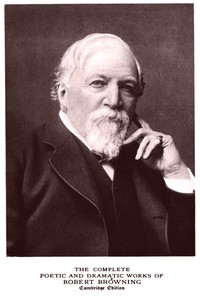
The Complete Poetic and Dramatic Works of Robert Browning by Robert Browning

(4 User reviews)   599
By Ashley Johnson Posted on Jan 12, 2026
In Category - Botany
Browning, Robert, 1812-1889 Browning, Robert, 1812-1889
English
Okay, I need you to picture this: a single book that holds the entire imaginative world of a poet who basically invented the psychological thriller in verse. This isn't your average poetry collection. Robert Browning is the master of the dramatic monologue, which means he gets inside the heads of some truly fascinating—and often deeply flawed—characters. You'll hear from a Renaissance duke showing off a painting of his late wife, a desperate lover in a storm, and scholars chasing impossible dreams. The main mystery in every poem isn't about 'whodunit,' but 'why did they do it?' Browning lets these characters talk, and as they try to justify themselves, they accidentally reveal their darkest secrets, their vanity, and their twisted logic. It's like being a fly on the wall for the most revealing confession you've ever heard.
Share

Read "The Complete Poetic and Dramatic Works of Robert Browning by Robert Browning" Online

This book is available in the public domain. Start reading the digital edition below.

START READING FULL BOOK
Instant Access    Mobile Friendly

Book Preview

A short preview of the book’s content is shown below to give you an idea of its style and themes.

in Dorsetshire, and his stock apparently was west-country English. Browning himself liked to believe that an earlier ancestor was a certain Captain Micaiah Browning who raised the siege of Derry in 1689 by an act of personal bravery which cost him his life. It is most to the point that Browning was London born with two generations of city Londoners behind him. His mother was Sarah Anne--a name which became Sarianna in the poet's sister--Wiedemann, the Scottish daughter of a Hamburg German, a shipowner in Dundee. The characters of the poet's parents are clearly defined. Robert Browning, senior, was a man of business who performed his business duties punctiliously, and by frugality acquired a tolerably comfortable fortune, but he was not a money-making man; his real life was in his books and in the gratification of literary and æsthetic tastes. He was a voracious reader, and in a prudent way a book and print collector. "It was his habit," says Mrs. Orr, "when he bought a book--which was generally an old one allowing of this addition--to have some pages of blank paper bound into it. These he filled with notes, chronological tables, or such other supplementary matter as would enhance the interest, or assist the mastering, of its contents: all written in a clear and firm, though by no means formal, handwriting." He had a talent for versifying which he used for his entertainment; he had a cheerful nature and that genuine sociability which made him a delightful companion in the small circle which satisfied his simple, ingenuous nature. He was born and bred in the Church of England, but in middle life became by choice a Dissenter, though never an exclusive one. Mrs. Browning, the poet's mother, was once described by Carlyle as "the true type of a Scottish gentlewoman." She inherited from her father a love for music and drawing which in him was manifested in execution, in her in good taste and appreciation. She was a woman of serene, gentle and affectionate nature, and of simple, earnest religious belief. She was brought up in the kirk of Scotland, but, like her husband, connected herself in middle life with the Congregationalists. She communicated of her own religious conviction to her children; it is said that she handed down also a nervous organization. Of these parents Robert Browning was born in the parish of St. Giles, Camberwell, London, May 7, 1812. He was the oldest of the small family, having two sisters, one, Clara, who died in childhood, and Sarianna, two years younger than himself, who outlived him. The country in which he was born and where he spent his childhood has been delightfully described by his great contemporary, Ruskin, whose Herne Hill was in the immediate neighborhood. Camberwell at that time was a suburb of London, with rural spaces and near access to the open country, though the stony foot of the metropolis was already stepping outward upon the pleasant lanes and fields. There was room for gardening and the keeping of pets, while the country gave opportunity for forays into nature's fastnesses. The boy kept owls and monkeys, magpies and hedgehogs, an eagle, snakes even, and was touched with the collector's pride, as when he started a collection of rare creatures with a couple of lady-birds brought home one winter day and placed in a box lined with cotton wool and labelled, "Animals found surviving in the depths of a severe winter." It is easy for a reader of his poems to detect the close, sympathetic observation which he disclosed for all lower life. Indeed the characteristics...

This is a limited preview. Download the book to read the full content.

This isn't a novel with one continuous plot, but a lifetime's worth of stories, plays, and poems all packed into one volume. Think of it as a grand gallery of voices. Each piece is a dramatic monologue, a solo performance where a character from history or Browning's imagination speaks directly to you. You'll meet a jealous Italian duke from the Renaissance, a grammarian who sacrificed his life for knowledge, and a lover racing through the night. There are also full-length verse plays set in complex historical moments. The 'story' in each work is driven by the speaker's urgent need to explain themselves, to persuade, or to confess, often revealing far more than they intend to.

Why You Should Read It

Browning's genius is in his understanding of human psychology. He doesn't tell you a character is arrogant or guilty; he lets them talk their way into that conclusion themselves. Reading him feels like solving a puzzle. You have to listen closely to what's said—and what's carefully left unsaid—to piece together the real truth. The language is rich and sometimes challenging, but the payoff is incredible. You get these stunning, timeless insights into ambition, art, love, and self-deception. It’s poetry that feels active and full of real, messy people.

Final Verdict

Perfect for readers who love character studies, historical settings, and the thrill of uncovering hidden motives. If you enjoy complex narrators like those in modern psychological novels or true crime podcasts, you'll find a kindred spirit in Browning. It's also a treasure trove for anyone who wants to see where so much of modern storytelling got its start. Be ready to read slowly, re-read passages, and have your perspective shifted. It's a commitment, but one that rewards you with some of the most vivid and unforgettable voices in all of English literature.


🔓 License Information

You are viewing a work that belongs to the global public domain. You can copy, modify, and distribute it freely.

Richard Mitchell
1 week ago

To be perfectly clear, the diagrams and footnotes included in this version are very helpful. This felt rewarding to read.

Kevin Brown
2 months ago

From a technical perspective, the author demonstrates strong mastery of the topic. This sets a high standard for similar books.

Joseph Hernandez
3 months ago

I almost skipped this one, yet the explanations are structured in a clear and logical manner. Worth every second of your time.

Richard Clark
1 month ago

I decided to give this a chance and the formatting of this PDF is flawless and easy to read on any device. A valuable addition to my digital library.

4.5
4.5 out of 5 (4 User reviews )

Add a Review

Your Rating *
There are no comments for this eBook.
You must log in to post a comment.
Log in

Related eBooks