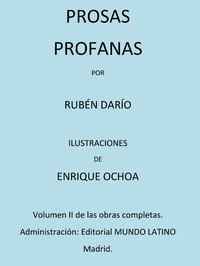
Prosas Profanas by Rubén Darío

(5 User reviews)   1038
Darío, Rubén, 1867-1916 Darío, Rubén, 1867-1916
Spanish
Hey, have you ever felt like you needed a complete shake-up of your creative world? That's exactly what Rubén Darío did for Spanish poetry with 'Prosas Profanas.' Forget the dusty, formal stuff you might associate with 19th-century verse. This book is a wild, musical party. It's full of swans, princesses, and mythological creatures, all written in a language so rich and rhythmic it feels like a spell. The real story isn't a single plot—it's the conflict between Darío's old world and the dazzling, modern, artistic universe he was determined to build. It's about breaking every rule to make something breathtakingly new. If you're curious about the moment poetry in Spanish got its color and sound turned all the way up, this is your starting point.
Share

Read "Prosas Profanas by Rubén Darío" Online

This book is available in the public domain. Start reading the digital edition below.

START READING FULL BOOK
Instant Access    Mobile Friendly

Book Preview

A short preview of the book’s content is shown below to give you an idea of its style and themes.

por Remy de Gourmont con el nombre de Celui-qui-ne-comprend-pas. Celui-qui-ne-comprend pas es, entre nosotros, profesor, académico correspondiente de la Real Academia Española, periodista, abogado, poeta, rastaquouer,_ b) _Porque la obra colectiva de los nuevos de América es aún vana, estando muchos de los mejores talentos en el limbo de un completo desconocimiento del mismo Arte a que se consagran._ c) _Porque proclamando, como proclamo, una estética acrática, la imposición de un modelo o de un código implicaría una contradicción._ _Yo no tengo literatura "mía"--como lo ha manifestado una magistral autoridad--, para marcar el rumbo de los demás: mi literatura es mía en mí--; quien siga servilmente mis huellas perderá su tesoro personal y, paje o esclavo, no podrá ocultar sello o librea. Wagner a Augusta Holmés, su discípula, dijo un día: "lo primero, no imitar a nadie, y sobre todo, a mí". Gran decir._ [Ilustración] _Yo he dicho, en la misa rosa de mi juventud, mis antífonas, mis secuencias, mis profanas prosas--. Tiempo y menos fatigas de alma y corazón me han hecho falta, para, como un buen monje artífice, hacer mis mayúsculas dignas de cada página del breviario. (A través de los fuegos divinos de las vidrieras historiadas, me río del viento que sopla afuera, del mal que pasa.) Tocad, campanas de oro, campanas de plata, tocad todos los días llamándome a la fiesta en que brillan los ojos de fuego, y las rosas de las bocas sangran delicias únicas. Mi órgano es un viejo clavicordio pompadour, al son del cual danzaron sus gavotas alegres abuelos; y el perfume de tu pecho es mi perfume, eterno incensario de carne, Varona inmortal, flor de mi costilla._ _Hombre soy._ [Ilustración] _¿Hay en mi sangre alguna gota de sangre de África, o de indio chorotega o nagrandano? Pudiera ser, a despecho de mis manos de marqués; mas he aquí que veréis en mis versos princesas, reyes, cosas imperiales, visiones de países lejanos o imposibles; ¡qué queréis! yo detesto la vida y el tiempo en que me tocó nacer; y a un presidente de República no podré saludarle en el idioma en que te cantaría a ti, ¡oh, Halagabal! de cuya corte--oro, seda, mármol--me acuerdo en sueños..._ (_Si hay poesía en nuestra América, ella está en las cosas viejas: en Palenke y Utatlán, en el indio legendario, y en el inca sensual y fino, y en el gran Moctezuma de la silla de oro. Lo demás es tuyo, demócrata Walt Whitman._) _Buenos Aires; Cosmópolis._ _¡Y mañana!_ [Ilustración] _El abuelo español de barba blanca me señala una serie de retratos ilustres: "Este, me dice, es el gran don Miguel de Cervantes Saavedra, genio y manco; éste es Lope de Vega, éste Garcilaso, éste Quintana." Yo le pregunto por el noble Gracián, por Teresa la Santa, por el bravo Góngora y el más fuerte de todos, don Francisco de Quevedo y Villegas. Después exclamo: ¡Shakespeare! ¡Dante! ¡Hugo...! (Y en mi interior: ¡Verlaine...!)_ _Luego al despedirme--: "Abuelo, preciso es decíroslo: mi esposa es de mi tierra; mi querida, de París."_ [Ilustración] _¿Y la cuestión métrica? ¿Y el ritmo?_ _Como cada palabra tiene una alma, hay en cada verso, además de la armonía verbal, una melodía ideal. La música es sólo de la idea, muchas veces._ [Ilustración] _La gritería de trescientas ocas no te impedirá, silvano, tocar tu encantadora flauta, con tal de que tu amigo el ruiseñor esté contento de tu melodía. Cuando él no esté para escucharte, cierra los ojos y toca para los habitantes de tu reino interior. ¡Oh, pueblo de desnudas ninfas, de rosadas reinas, de amorosas diosas!_ _Cae a tus pies una...

This is a limited preview. Download the book to read the full content.

Let's be clear: Prosas Profanas isn't a novel with a plot in the usual sense. It's a collection of poems, but think of it as a single, grand artistic statement. Darío was done with the sober, traditional poetry of his time. This book is his declaration of independence. He fills it with symbols from French Parnassianism and symbolism—think elegant swans, exotic princesses, and references to Greek myths—but he uses them to craft something entirely fresh in Spanish. The 'story' here is the journey of language itself, breaking free from its chains and learning to dance, sing, and paint vivid pictures.

Why You Should Read It

You should read this to feel the pure joy of language. Even in translation (though reading some Spanish aloud is a treat), you can sense the music Darío wove into every line. It's not just what he says—it's how he says it. The themes are decadent and beautiful, celebrating art for art's sake. It can feel like wandering through a lush, slightly surreal garden. Reading Darío, you understand why he's called the father of Modernismo; you're witnessing the birth of a new sensibility that would influence generations of writers across Latin America and Spain.

Final Verdict

This book is perfect for poetry lovers who want to explore the roots of modern Spanish-language verse, or for any reader who appreciates lush, sensory writing. It's also great for history of art buffs, as it captures a pivotal cultural moment. If you prefer straightforward narratives, this might feel abstract. But if you're willing to let the sound and imagery wash over you, Prosas Profanas is a dazzling, essential performance.


🏛️ Free to Use

This book is widely considered to be in the public domain. Use this text in your own projects freely.

Liam Thomas
3 weeks ago

After spending time with this material, the translation seems very fluid and captures the original nuance perfectly. I have no regrets downloading this.

Aiden Young
4 months ago

A fantastic discovery, the structure supports both quick reading and deep study. It exceeded all my expectations.

Margaret Gonzalez
4 months ago

At first glance, the style is confident yet approachable. Truly inspiring.

Joshua Anderson
1 month ago

Having read this twice, the balance between theory and practice is exceptionally well done. It is definitely a 5-star read from me.

Ashley Scott
4 months ago

I found this while browsing online and it manages to explain difficult concepts in plain English. This deserves far more attention.

4
4 out of 5 (5 User reviews )

Add a Review

Your Rating *
There are no comments for this eBook.
You must log in to post a comment.
Log in

Related eBooks