1

Ye butcher, ye baker, ye candlestick-maker — Key Ideas to Explore
(0 User reviews)
348
Project Gutenberg
2024
Not confirmed
Humorous poetry, American; Occupations -- Poetry; Occupations -- Humor
Readers of public-domain and historical texts
Project Gutenberg digital edition
en
Edition facts
Words
4,807
Reading time
21 min
Text sections
24
Ye butcher, ye baker, ye candlestick-maker — Key Ideas to Explore can be approached with a clearer sense of reading commitment from its source measurements: 4,807 words, 21 min estimated reading time, and 24 detected text sections.
The text analysis averages about 24.3 words per sentence, while the detected sections provide another way to judge how the source is divided.
Project Gutenberg metadata also associates the work with “Humorous poetry, American,” connecting these edition facts with the source record’s subject description.
Source:
Project Gutenberg record #73649
Robert Seaver's 1908 collection of humorous verses uses 18 trades to contrast old-fashioned manual labor with modern convenience, each poem anchored by a woodcut and a wry couplet about progress.
Read the complete public-domain text at its original source.
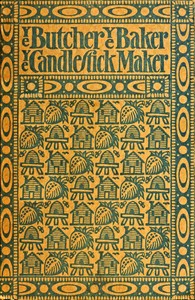
Read on Project GutenbergRobert Seaver's Ye butcher, ye baker, ye candlestick-maker (1908) is a sequence of eighteen short poems, each devoted to a trade or figure from an earlier era—housewife, baker, doctor, town crier, tythingman, pirate, pedagogue, chemist, merchant, printer, brewer, robber, tailor, chandler, student, husbandman, jester, and the titular butcher and candlestick-maker. The verses are printed in an archaic style, with 'ye' and 'doth,' and each is paired with a woodcut illustration by the author. The collection's structure is straightforward: one poem per occupation, each ending with a couplet that contrasts the old way with a modern replacement—such as the baker whose fragrant shop is superseded by canned goods. The humor lies in the deadpan delivery of these transitions, which treat progress as inevitable and slightly absurd.
A Catalogue of Trades, Each a Miniature Scene
The book's organizing principle is a simple list of occupations, but within that framework Seaver creates distinct vignettes. The housewife is shown in her 'kitchen white,' scouring pots and baking bread; the baker's shop is spied by a schoolboy, with 'men of gingerbread in state / With eyes of currants lie'; the doctor rides a 'faithful nag' with saddlebags full of physic. Each poem is a self-contained scene, often anchored by a single vivid image—the town crier ringing his bell, the tythingman watching for Sabbath-breakers. The woodcuts, mentioned in the subtitle as 'numerous,' would have reinforced these visual snapshots. The catalogue form allows Seaver to move briskly from one figure to the next, creating a cumulative portrait of a pre-industrial community, but without narrative connection between the poems.
The Recurring Pattern: Then and Now
Nearly every poem follows a two-part structure: a description of the trade as it was practiced 'many years ago,' followed by a closing couplet that introduces a modern replacement. The baker's couplet reads: 'All this was many years ago, / Before Ye Canner came, / With Fifty-nine Varieties / To advertise his name.' The doctor's verse ends: 'Ye ancient steed is seen no more, / Ye doctor telephones / An absent treatment, or, perchance, / Manipulates ye bones.' This pattern is consistent across the excerpts: the housewife's labor is contrasted with 'Ye Modern Servant' (who has not yet been made by the Adversary); the town crier's bell is replaced by—presumably—newer media. The repetition of this structure gives the collection a rhythmic predictability, and the humor often depends on the specific, anachronistic detail of the modern invention (the telephone, the canner's 'Fifty-nine Varieties').
Archaic Diction and the Woodcut Aesthetic
Seaver adopts an intentionally old-fashioned voice, using 'ye,' 'doth,' 'espy,' and 'goodman' throughout. This is not a genuine attempt at historical accuracy but a stylistic choice that aligns with the woodcut illustrations and the book's subtitle: 'Being sundry amusing and instructive verses for both old and young, adorned with numerous woodcuts.' The archaic language creates a playful distance between the reader and the subject matter, as if the poems themselves are artifacts from the era they describe. The woodcuts—likely in a similar style to those advertised in the front matter for other books by Seaver—would have reinforced this antiquarian feel. The combination of faux-old language and modern punchlines (telephones, canned goods) produces a gentle satire of nostalgia itself: the past is quaint, but the present has its own absurdities.
Movement Between Scenes: No Plot, Only Sequence
The book has no overarching narrative; the poems are arranged in a fixed order (as shown in the table of contents) but do not build on one another. The reader moves from the housewife to the baker to the doctor to the town crier, and so on, without any connective tissue. This sequential structure means the book can be opened at any point, but reading straight through creates a rhythm of expectation: each new poem will introduce a trade, describe its old methods, and then undercut it with a modern twist. The lack of plot is compensated by the variety of occupations—from the pirate to the pedagogue to the jester—which keeps the sequence from becoming monotonous. The movement is not geographical or temporal but categorical: a parade of figures, each stepping forward for a single stanza before yielding to the next.
Readers approaching Seaver's collection should expect a series of self-contained comic poems rather than a continuous story. The pleasure lies in the specific details—the gingerbread men with currant eyes, the doctor's 'faithful nag'—and in the wry recognition that every trade has been transformed by technology. The woodcuts, though not reproduced in this digital edition, are integral to the work's effect; the verses themselves often describe what the pictures might show. For those interested in early twentieth-century humor or in the intersection of poetry and illustration, this slim volume offers a compact, patterned example of both.
That old book of trades left me thinking about how we measure progress—the way a candlestick maker’s hands hold a story no machine can tell. It reminded me of another quiet collection, The Three Taverns: A Book of Poems — Key Ideas to Explore, where the same ache for something slower lingers between the lines. Some verses just stay, like a familiar street at dusk.
There are no reviews for this eBook.
There are no comments for this eBook.
Reader reflection
Take a moment to reflect on this book
Create a short personal record of your experience with this book.
Your progress
0
/
10
2
How did the book work for you overall?
3
Would you encourage someone else to read it?
4
How easy was the book to follow?
5
Would you like to discuss this book with someone?
6
Was the book what you thought it would be?
7
Do you expect to return to this book?
8
How clear did the writing feel?
9
What changed or sharpened your thinking?
10