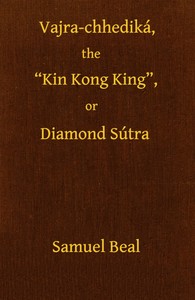
Vajra-chhediká, the "Kin Kong King," or Diamond Sútra by Unknown

(4 User reviews)   1023
By Ashley Johnson Posted on Jan 12, 2026
In Category - Herbal Studies
Unknown Unknown
English
Ever had a thought that felt completely solid, like a fact of the universe? What if it's not? That's the core question of this ancient, mind-bending text. Forget a plot with characters—this is a conversation that pulls the rug out from under everything you think you know. The Buddha and a disciple talk about reality, perception, and what it means to truly understand something. It sounds heavy, but the ideas are shockingly direct. It's a short read that will have you staring at the wall, questioning the nature of your own thoughts. If you're up for a philosophical puzzle that's survived over a thousand years, this is it.
Share

Read "Vajra-chhediká, the "Kin Kong King," or Diamond Sútra by Unknown" Online

This book is available in the public domain. Start reading the digital edition below.

START READING FULL BOOK
Instant Access    Mobile Friendly

Book Preview

A short preview of the book’s content is shown below to give you an idea of its style and themes.

the heir-apparent, had bestowed on the compassionate (Sudana). Here, then, was Buddha, surrounded by all the multitude of the great Bhikshus (religious mendicants, the general title of Buddha’s followers), 1250 in number. Then the world-honoured one, it being now the time of providing food, having put on his robe, and taken his alms-bowl, entered the great city of Śrávastí, for the purpose of begging a supply. Having gone in order through the midst of the city, begging food in a regular manner, he now returned to his former retreat, where, having eaten the food he had received as alms, and having laid aside his robe and alms-bowl, he washed his feet, and then, arranging his seat, he sat down. _Cap. II. contains the respectful request of the aged Subhúti._[3] At this time the distinguished and venerable Subhúti sat in the midst of the assembly. Then rising forthwith from his seat, he uncovered his right shoulder, and with his right knee knelt on the ground; then closing together the palms of his hands, and raising them in a respectful manner to Buddha, he spoke thus: Oh! much-desired! world-honoured one! Tathágata ever regards and illustriously protects all the Bodhisatwas! he ever rightly instructs them! World-honoured one! if a virtuous disciple, male or female, aspire after (the attainment of) the “unsurpassed, just, and enlightened heart,”[4] say on what ought that disciple to fix his reliance, say how ought that disciple to repress and subdue the evil emotions of this sinful heart?[5] Buddha said: Good! good! (sádhu). Subhúti! it is as you say. Tathágata is ever mindful of and illustriously defends all the Bodhisatwas, and he ever instructs them in right. You therefore listen now and examine well what, for your sake, I declare. The worthy disciple, whether male or female, who aspires after the attainment of the perfectly just, unsurpassed, and enlightened heart, ought to rely on what I shall now explain, ought to subdue the risings of his corrupt heart in the way I shall now exhibit! Ah! yes, world-honoured one! would that you would so far gratify us all, anxious to hear. _Cap. III. exhibits the true distinctive character of the Great Vehicle._ Buddha said: Subhúti, all the Bodhisatwas and great Bodhisatwas ought thus to subdue and repress the risings of this corrupt heart. Whatever species of creature there be, whether oviparous or viviparous, born from spawn or by transformation, possessing a material form or not, liable to the laws of mind or not, not altogether possessed of mental organization nor yet entirely without it—all these I command and exhort to enter on the state of the unsurpassed Nirváṅa (Pari nirváṅa[6]) and for ever to free themselves from the conditions of being to which they severally belong. The great family of sentient beings, immeasurable, vast, numberless, being thus freed from such states of existence, then indeed there will be no longer any such beings to arrive at this position of perfect freedom. I conclude, therefore, Subhúti, if there be a Bodhisatwa affected with any selfish distinction, or any social distinction,[7] or any distinction as a sentient being, or any distinction as a finite and perishable being, then this Bodhisatwa is not one in reality. _Cap. IV.—The characteristic of the most perfect line of conduct, is, that it is spontaneous._ Moreover, Subhúti, a Bodhisatwa in the active discharge of his functions ought to be without any object of reliance or desire (_i.e._, unaffected by any secondary object in the discharge of his chief business). When occupied, for instance, in attending to the work of charity—his ought to be that charity which is...

This is a limited preview. Download the book to read the full content.

Okay, let's get this out of the way: this isn't a novel. There's no hero's journey or love triangle. The Diamond Sutra is a recorded conversation, a teaching session where the Buddha's disciple Subhuti asks a big question: How should someone set out on the path to enlightenment?

The Story

The Buddha's answer is a series of paradoxical statements designed to break our usual way of thinking. He talks about helping countless beings, but then says no beings have been helped. He discusses sacred teachings, but calls them not-teachings. The whole point is to show that fixed ideas and concepts—even spiritual ones—are like illusions. The famous line is the heart of it: "All conditioned phenomena are like a dream, an illusion, a bubble, a shadow..." The 'story' is the unraveling of the reader's own assumptions.

Why You Should Read It

I love this because it's intellectual kung fu. It doesn't add more philosophy to your brain; it tries to clear space. Reading it feels like mental spring cleaning. The repetitive, puzzle-like style is frustrating at first, but then it becomes almost hypnotic. It challenges the very way we build our sense of self and world. You don't have to agree with it to find it fascinating. It's a workout for your perspective.

Final Verdict

Perfect for curious minds who enjoy philosophy, psychology, or just a good brain teaser. If you liked the questioning nature of The Matrix or modern books on perception, this is the ancient source material. It's not for someone looking for a linear narrative, but for a reader ready to have a 1,500-year-old conversation that still feels radically fresh.


⚖️ No Rights Reserved

This book is widely considered to be in the public domain. You are welcome to share this with anyone.

Charles Anderson
2 months ago

I rarely write reviews but the author clearly understands the subject matter in depth. This was both informative and enjoyable.

Sarah Clark
2 months ago

This came highly recommended and the arguments are well-supported by credible references. A valuable addition to my digital library.

Carol Lopez
3 months ago

This is one of those books where it manages to explain difficult concepts in plain English. I finished this feeling genuinely satisfied.

Michelle Thomas
5 months ago

At first I wasn’t convinced, but the interplay between the protagonists drives the story forward beautifully. Simply brilliant.

4
4 out of 5 (4 User reviews )

Add a Review

Your Rating *
There are no comments for this eBook.
You must log in to post a comment.
Log in

Related eBooks