1

The whore — Reading Companion
(0 User reviews)
283
Project Gutenberg
2024
Not confirmed
English poetry -- 18th century; Sexual ethics -- Poetry; Prostitutes -- Poetry
Readers of public-domain and historical texts
Project Gutenberg digital edition
en
Edition facts
Words
6,169
Reading time
27 min
Text sections
4
The catalog record for The whore — Reading Companion provides practical reading context through 6,169 words, 27 min estimated reading time, and 4 detected text sections.
The text analysis averages about 24.9 words per sentence, while the detected sections provide another way to judge how the source is divided.
Project Gutenberg metadata also associates the work with “English poetry -- 18th century,” connecting these edition facts with the source record’s subject description.
Source:
Project Gutenberg record #74357
An 18th-century poem by a self-identified 'Whore of Quality' that satirizes sexual hypocrisy, using biblical allusion and direct address to critique the double standards that force women into prostitution.
Read the complete public-domain text at its original source.
Read on Project GutenbergThe poem opens with a defiant epigraph—'Of all the Crimes condemn’d in Woman-Kind, / WHORE, in the Catalogue, the First you’ll find'—and immediately establishes a combative, ironic voice. The author, styling herself a 'Whore of Quality,' dedicates the work to a list of named ladies and a 'Bird of Paradise,' blending mock-heroic dedication with street-level pamphlet culture. The verse moves between abstract questions ('what’s a Whore?') and pointed social commentary, using the Garden of Eden as a recurring touchstone. The speaker’s tone shifts from sardonic to indignant, especially when tracing how 'vile man' first makes a woman a whore and then condemns her.
The Speaker’s Self-Fashioning
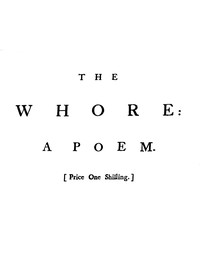
The title page announces the poem as 'Written by a WHORE of Quality,' a paradoxical label that fuses social rank with stigmatized identity. The speaker claims sisterhood with her audience—'ye sisters all attend, / Give your applause, and be a sister’s friend'—while daring critics she calls 'Sons of Whores.' This rhetorical posture allows the poem to inhabit the very category it examines. The dedication to specific society women (L——r, G——r, W——y) and to a 'Bird of Paradise' suggests a knowing coterie readership. The speaker positions herself as both insider and outcast, using the authority of experience to challenge moral condemnation.
Biblical Argument and Sexual Logic
The poem reinterprets the Fall of Eve as a sexual transgression: 'What was the fruit the Tree of Knowledge shew’d, / And made her break her promise to her God? / What in the serpent could o’er her prevail; / Was the great EVIL in his head or TAIL?' The pun on 'tail' reduces theological mystery to bodily appetite. Later, the speaker invokes Newton—likely the notorious courtesan—who 'like a cunning elf, / As spousy could not carve—she help’d herself.' These allusions reframe female desire as natural and male impotence as a failure of obligation. The poem’s logic insists that necessity, whether economic or physical, justifies what society calls whoredom.
The Economics of Ruin
The poem traces a grim progression from seduction to destitution. A man 'works into her folly by degrees' until 'the whole pile falls down,' leaving the woman 'to Death, Diseases, and Despair.' The final couplet—'Yet ev’ry one of feeling must deplore, / That man, vile man, first made the wretch a WHORE'—shifts blame from the woman to her seducer. The poem’s structure mirrors this downward arc: it begins with abstract debate and ends with a tableau of a woman dying on a 'laystall' (a dung heap). The speaker insists that prostitution is not a choice but a last resort when 'Nature cries out, and hunger must be fed.'
Diction and the Pamphlet Aesthetic
The poem’s language oscillates between elevated couplets and coarse directness. Words like 'whore,' 'tail,' and 'laystall' sit alongside 'Cyprian Deity' and 'loose rob’d Goddess of Delight.' This mix of registers reflects the poem’s hybrid form: part Juvenalian satire, part street-level polemic. The meter is regular heroic couplets, but the content repeatedly undercuts decorum. The author’s note that the poem is 'sold at the Pamphlet-Shop opposite Anderton’s Coffee-House' grounds it in the ephemeral print culture of 18th-century London. The poem’s rough edges—abrupt transitions, repeated exclamations—suggest a performance meant to provoke, not to please.
Readers should attend to the poem’s strategic use of biblical and classical allusion as a cover for explicit social critique. The speaker’s persona—learned, angry, and self-consciously degraded—complicates any simple reading as autobiography or fiction. The surviving text is short, but its compressed arguments reward attention to how the poet manipulates couplet form to deliver punchlines and reversals. Compare the opening dedication’s mock-heroic tone with the closing scene of a woman dying on a dung heap: the gap between these registers is the poem’s central argument.
Some evenings, I pull down that old poem, its author calling herself a Whore of Quality, and I hear her weary laughter at the world’s double standards. It reminds me of another voice, softer but no less knowing, inside Sonnets on Sundry Notes of Music — Inside the Classic. Both understood how love and shame get tangled. They sit apart on my shelf, yet keep each other company.
There are no reviews for this eBook.
There are no comments for this eBook.
Reader reflection
Before you leave, reflect on the book
Use these questions to collect your thoughts before moving on.
Your progress
0
/
10
2
What was your overall reaction to the book?
3
Would you encourage someone else to read it?
4
How demanding did the text feel?
5
How valuable was this book for your own interests?
6
Did the story or argument move comfortably?
7
Did any part of the book feel personally relevant?
8
What was its emotional impact?
9
What changed or sharpened your thinking?
10