1

The poetic Edda — Story, Setting & Ideas
(0 User reviews)
91
Project Gutenberg
2024
Not confirmed
Eddas -- Translations into English; Old Norse poetry -- Translations into English; Mythology, Norse -- Poetry -- Translations into English; Edda Sæmundar -- Translations into English
Readers of public-domain and historical texts
Project Gutenberg digital edition
en
Edition facts
Words
148,970
Reading time
648 min
Text sections
39
The catalog record for The poetic Edda — Story, Setting & Ideas provides practical reading context through 148,970 words, 10 hr 48 min estimated reading time, and 39 detected text sections.
The text analysis averages about 16.0 words per sentence, while the detected sections provide another way to judge how the source is divided.
Project Gutenberg metadata also associates the work with “Eddas -- Translations into English,” connecting these edition facts with the source record’s subject description.
Source:
Project Gutenberg record #73533
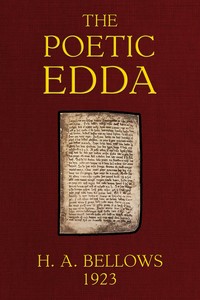
Henry Adams Bellows' 1923 translation of the Poetic Edda, with notes clarifying kennings, manuscript gaps, and mythological overlaps. The volume preserves the alliterative verse and abrupt shifts between gnomic wisdom, myth, and heroic elegy, offering a scholarly yet readable entry into Old Norse poetry.
Read the complete public-domain text at its original source.
Read on Project GutenbergBellows' translation of the Poetic Edda, first published in 1923, renders the Old Norse alliterative verse into a modern English equivalent that preserves the original's characteristic stress patterns and kennings. The volume includes extensive footnotes that clarify manuscript ambiguities—such as missing stanzas indicated by gaps—and explain mythological references like the identification of Valkyries with clouds or the southern origin of certain swan-maidens. Bellows also notes where the prose annotations in the manuscript contradict or complicate the verse, as when the Helgi poems treat Hunding as both a single king and a line of kings.
Voice and Alliterative Structure
The translation maintains a consistent four-beat line with alliteration on stressed syllables, mirroring the Old Norse form. Bellows' notes frequently comment on metrical choices, such as when he fills a conjectural line with “He saw there mighty maidens riding” to complete a stanza. The verse shifts between gnomic pronouncements—like the Hovamol's maxims—and the rapid, dialogue-driven exchanges of poems like Lokasenna. In the heroic lays, the alliteration often underscores key nouns: “Breaker of rings” for a generous prince, or “Wolf-wood” for a dark forest. This technique gives the translation a rhythmic urgency that matches the original's oral-formulaic character.
Pacing Through Manuscript Gaps and Prose Inserts
Bellows repeatedly signals where the manuscript indicates a lacuna or a stanza break. In Helgakvitha Hundingsbana I, he notes that “no gap indicated in the manuscript, but almost certainly something has been lost” before the Valkyries' arrival. Such editorial interventions create a staccato reading experience: the verse halts, the note explains, and the narrative resumes. The prose passages that introduce or interrupt the poems—like the account of Hunding's sons in the Sigurth cycle—serve as bridges between poetic fragments. Bellows treats these prose sections as integral to the pacing, using them to clarify chronology without smoothing over the original's abrupt transitions.
Kennings and Geographic Specificity
The translation preserves kennings that anchor the verse in a concrete, often violent landscape: “Vithrir's hounds” for wolves, “water's gleam” for gold. Bellows' footnotes decode these compounds without stripping their poetic force. Geographic names—Orvasund (the Öresund), Logafjoll (“Flame-Mountain”), Brandey (“Brand-Isle”)—are left untranslated, with brief identifications that root the myths in real or legendary Northern places. The notes also track how the same place-name shifts meaning across poems: Hethinsey is glossed as possibly Hiddensee, while Tronueyr is simply “Crane-Strand.” This attention to geography gives the Edda a layered sense of space, where mythical mountains coexist with Danish straits.
Readers should attend to Bellows' footnotes as a parallel text: they reveal where the translator had to guess, where the manuscript contradicts itself, and where later sagas rework the same material. The volume rewards those who read both the verse and the apparatus, treating the gaps and annotations not as flaws but as evidence of a living, unstable tradition. Approach the poems as fragments that cohere through their shared alliterative pulse and their persistent return to questions of fate, honor, and the cost of knowledge.
Reading Bellows’ sparse notes on the Edda’s broken lines, I remembered the dog-eared copy of Colors of Life: Poems and Songs and Sonnets — A Reader’s Guide my mother kept by the window. Both books feel like old friends who know their silences. There’s comfort in a missing stanza, a half-finished thought; it leaves room for my own quiet pause.
There are no reviews for this eBook.
There are no comments for this eBook.
Reader reflection
What was your reading experience?
Capture what you thought, learned, and would like to remember.
Your progress
0
/
10
2
Did this book hold your interest?
3
Is this a title you would suggest to others?
4
What was the reading difficulty like?
5
How did the reading compare with what you expected?
6
Would a second reading be valuable?
7
Did it raise ideas you would like to talk about?
8
What did you think about the pace?
9
What is the main idea you are taking away?
10