1

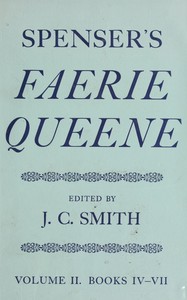
Spenser's Faerie Queene, Vol. 2 (of 2) — A Closer Reading
(0 User reviews)
118
Project Gutenberg
2024
Not confirmed
English poetry -- Early modern, 1500-1700; Knights and knighthood -- Poetry; Virtues -- Poetry
Readers of public-domain and historical texts
Project Gutenberg digital edition
en
Edition facts
Words
156,818
Reading time
682 min
Text sections
58
The source record for Spenser's Faerie Queene, Vol. 2 (of 2) — A Closer Reading measures this digital text at 156,818 words, 11 hr 22 min estimated reading time, and 58 detected text sections.
The text analysis averages about 34.0 words per sentence, while the detected sections provide another way to judge how the source is divided.
Project Gutenberg metadata also associates the work with “English poetry -- Early modern, 1500-1700,” connecting these edition facts with the source record’s subject description.
Source:
Project Gutenberg record #72698
This volume of Spenser's Faerie Queene covers Books IV–VII, including the Legend of Friendship, Justice, Courtesy, and the Mutability Cantos. The editor J. C. Smith provides a scholarly edition with critical apparatus, based on the 1596 quarto.
Read the complete public-domain text at its original source.
Read on Project GutenbergThis second volume of J. C. Smith's edition of The Faerie Queene presents Books IV through VII, completing the epic's second part. The text is based on the 1596 quarto, with editorial notes and a critical appendix. Readers encounter the legends of Cambel and Telamond (Friendship), Artegall (Justice), Calidore (Courtesy), and the fragmentary Mutability Cantos. Smith's edition preserves Spenser's archaic spelling and stanza numbering, offering a reliable text for study.
Structure and Stanza Form
Spenser's distinctive stanza—eight iambic pentameter lines followed by an alexandrine—remains consistent across these books. The rhyme scheme (ababbcbcc) creates a forward momentum that suits the narrative's episodic adventures. Smith's edition retains the original stanza numbers in the margin, allowing readers to track the poem's architecture. The volume includes a letter to Sir Walter Raleigh, where Spenser outlines his allegorical method, and commendatory verses that situate the work within Elizabethan literary culture.
Recurring Images of Devouring and Transformation
In the excerpt from Book V, the tyrant Geryoneo devours twelve of Belge's seventeen sons, sacrificing them to idols. The monster is described with "three bodies in one wast empight" and a two-headed dog Orthrus. This imagery of consumption and bodily distortion recurs throughout the volume, from the Blatant Beast's slanderous tongues to the Mutability Cantos' cosmic flux. Spenser uses such figures to explore how virtue contends with forces that threaten to consume order.
Movement Between Courtly and Wilderness Settings
The narrative oscillates between courtly spaces—like Mercilla's palace, where Artegall witnesses justice tempered with mercy—and wild landscapes where knights encounter monsters and errant figures. In Book VI, Calidore pursues the Blatant Beast through forests and pastoral retreats. This spatial alternation mirrors the moral geography of the poem: virtue is tested in isolation and confirmed in society. Smith's edition preserves the original spelling of place names, such as "Belge" for the Low Countries, grounding allegory in contemporary geopolitics.
Editorial Apparatus and Textual Notes
Smith provides a critical appendix that collates variant readings from early editions, including the 1590 and 1596 quartos and the 1609 folio. The notes clarify obscure allusions, such as the reference to Geryon's cattle and the myth of Hercules. This apparatus is essential for scholars tracing Spenser's revisions. The volume also includes dedicatory sonnets to Elizabethan patrons, revealing the poet's network of support. Readers should consult the notes alongside the poem to appreciate the textual decisions that shape this edition.
Smith's edition offers a reliable entry point for readers engaging with the second half of The Faerie Queene. Pay attention to the marginal stanza numbers and the critical apparatus, which illuminate Spenser's allegorical design. The volume's preservation of archaic spelling rewards slow reading, allowing the poem's sonic and semantic textures to emerge.
Leafing through Spenser’s intricate courtly allegories, I found myself missing the plain, weathered honesty of old ballads. His knights move with such deliberate grace, yet my mind kept wandering to simpler voices—ones that stumble and repeat, singing of loss without a moral. It felt like turning from a grand tapestry to a worn wooden bench. That quiet ache led me back to A Book of Old Ballads — Volume 2 — A Closer Reading, where every refrain feels like a memory I’ve always carried.
There are no reviews for this eBook.
There are no comments for this eBook.
Reader reflection
Before you leave, reflect on the book
Use these questions to collect your thoughts before moving on.
Your progress
0
/
10
2
What was your overall reaction to the book?
3
Would you pass this book on to a friend?
4
How easy was the book to follow?
5
Did you relate to its people, ideas, or situations?
6
Could you apply anything you learned?
7
How clear did the writing feel?
8
Which part made the strongest impression?
9
In one sentence, what did you learn?
10