1

Spenser's Faerie Queene, Vol. 1 (of 2) — Key Ideas to Explore
(0 User reviews)
105
Project Gutenberg
2023
Not confirmed
English poetry -- Early modern, 1500-1700; Knights and knighthood -- Poetry; Virtues -- Poetry
Readers of public-domain and historical texts
Project Gutenberg digital edition
en
Edition facts
Words
158,242
Reading time
689 min
Text sections
67
Spenser's Faerie Queene, Vol. 1 (of 2) — Key Ideas to Explore can be approached with a clearer sense of reading commitment from its source measurements: 158,242 words, 11 hr 29 min estimated reading time, and 67 detected text sections.
The text analysis averages about 40.5 words per sentence, while the detected sections provide another way to judge how the source is divided.
Project Gutenberg metadata also associates the work with “English poetry -- Early modern, 1500-1700,” connecting these edition facts with the source record’s subject description.
Source:
Project Gutenberg record #70717
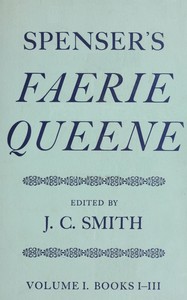
J. C. Smith's 1909 edition of Spenser's Faerie Queene, Books I-III, with textual variants from 1590, 1596, and 1609. The editor's introduction details phonological and grammatical shifts, such as 'seeldome' to 'seldome' and the loss of syllabic -es. Excerpts show Spenser's allegorical garden of Proserpina, with Tantalus's torment and golden apples from classical myths.
Read the complete public-domain text at its original source.
Read on Project GutenbergJ. C. Smith's edition of The Faerie Queene, Books I–III, offers a text grounded in collation of the 1590 and 1596 Quartos and the 1609 Folio. The editor's introduction foregrounds linguistic detail: he records variants like 'seeldome' (1590) becoming 'seldome' (1596) and 'sildom' (1609), and notes the gradual disappearance of syllabic -es in possessives and plurals. Smith also observes that 'since' and 'sith' were used interchangeably in early editions, but 1609 attempts to assign 'since' to temporal and 'sith' to causal senses—a shift that did not save the older form.
These textual choices matter because Spenser's deliberate archaism makes even small variants significant for understanding Elizabethan phonology, grammar, and usage. The edition's notes record all verbal differences and punctuation changes that imply altered meaning, providing a resource for studying how the poem's sound and sense evolved across early printings.
Allegorical Landscapes and Classical Allusions
The excerpt from Book II presents the Garden of Proserpina, a space where Spenser's allegorical method intertwines with classical mythology. The garden is 'goodly garnished / With hearbs and fruits, whose kinds mote not be red'—plants that are 'direfull deadly blacke both leafe and bloom,' fit 'to adorne the dead.' Spenser lists 'mournfull Cypresse,' 'bitter Gall,' 'Dead sleeping Poppy,' and 'blacke Hellebore,' drawing on a tradition of poisonous flora from Ovid and Pliny. The catalogue includes 'Cicuta bad,' the hemlock that killed Socrates, explicitly linking the garden to philosophical martyrdom.
At the garden's center grows a tree with 'golden apples glistring bright,' which Spenser connects to the Hesperides, Atalanta's race, and the Apple of Discord thrown by Eris (here 'false Ate'). These allusions are not mere decoration; they create a network of moral and narrative associations. The golden apple that 'many noble Greekes and Troians made to bleed' foreshadows the poem's own themes of strife and desire. The garden is bounded by the river Cocytus, where 'full many soules do endlesse waile and weepe,' and within it Tantalus suffers his eternal hunger and thirst. Spenser's description of Tantalus—'Deepe was he drenched to the vpmost chin, / Yet gaped still, as coueting to drinke'—renders the classical punishment with visceral immediacy, while the knight's questioning of Tantalus introduces a dialogic element that breaks the descriptive surface.
Narrative Voice and Shifts in Pace
The passage moves from static description to dramatic encounter, illustrating Spenser's control of narrative pace. The opening stanzas build the garden through accumulation: a list of plants, the silver seat, the arbor, the tree. The syntax is paratactic, with clauses linked by 'And' and 'There,' creating a slow, incantatory rhythm. The repeated 'goodly' and 'faire' reinforce a sense of deceptive beauty.
When the knight climbs the bank to look into Cocytus, the pace quickens. The line 'Which to behold, he clomb vp to the banke' shifts from description to action. The following stanza introduces 'many damned wights' and their 'piteous cryes, and yelling shrights,' with the verb 'resounden wide' echoing across the landscape. The focus narrows to 'One cursed creature'—Tantalus—and the stanza structure tightens: each quatrain details a specific aspect of his torment (drenched to the chin, gaping, stretching his hand). The repetition of 'fruit from hand, and floud from mouth / Did flie abacke' creates a rhythmic pattern of frustration. The knight's direct question, 'Askt who he was, and what he ment thereby,' introduces a new voice and a shift to dialogue, breaking the earlier descriptive mode and adding a layer of moral inquiry.
Textual Variants and Editorial Choices
Smith's edition foregrounds the instability of Spenser's text. The introduction records that the 1609 Folio systematically altered 'since' and 'sith' to distinguish temporal from causal uses, though inconsistently. This editorial intervention reflects changing linguistic norms: by 1609, 'sith' was becoming archaic, and the Folio editor attempted to rationalize usage. Smith also notes the loss of syllabic -es in possessives and plurals, a feature that affected meter and pronunciation.
In the excerpt, the spelling 'glistring' (for 'glistening') and 'dempt' (for 'deemed') illustrate Spenser's archaizing tendencies. The variant 'seeldome' (1590) vs. 'seldome' (1596) suggests a fluid e-sound. Smith's method is to record all verbal differences and punctuation changes that imply a different view of meaning, while ignoring mere spelling changes that do not affect pronunciation. This approach allows readers to trace how the poem's language shifted across editions, but Smith cautions that the evidence must be used with care given Spenser's deliberate archaism. The edition thus becomes a tool for studying both the poem and the history of English.
Readers approaching this edition should attend to the textual notes as well as the poem itself. Smith's collation reveals how early editors and compositors shaped Spenser's language, sometimes smoothing archaisms, sometimes introducing new forms. The excerpts show that even small variants—a dropped syllable, a substituted conjunction—can affect rhythm and meaning. For those interested in Elizabethan poetics, this volume offers a chance to see the poem in flux, not as a fixed monument but as a living text subject to the pressures of print and linguistic change.
Leafing through Smith’s old Spenserian variants—watching “seeldome” settle into “seldome”—I felt that same quiet ache of words shifting shape, like remembering a voice slightly changed. It called to mind the musical fragility in Sonnets on Sundry Notes of Music — Inside the Classic, where each line feels caught mid-breath, half-spoken, half-sung. A gentle echo, nothing more.
There are no reviews for this eBook.
There are no comments for this eBook.
Reader reflection
Record your reading impressions
A brief reflection can help important ideas stay with you longer.
Your progress
0
/
10
2
What was your overall reaction to the book?
3
Is this a title you would suggest to others?
4
What was the reading difficulty like?
5
How much did the book move you?
6
Could you apply anything you learned?
7
How personally connected did you feel to the book?
8
Which element worked best for you?
9
In one sentence, what did you learn?
10