1

Land of play: Verses, rhymes, stories — A Closer Reading
(0 User reviews)
477
Project Gutenberg
2022
Not confirmed
Children's literature; Children's poetry; Nursery rhymes; Counting-out rhymes
Readers of public-domain and historical texts
Project Gutenberg digital edition
en
Edition facts
Words
24,346
Reading time
106 min
Text sections
182
Before opening Land of play: Verses, rhymes, stories — A Closer Reading, the edition data offers a quick orientation: 24,346 words, 1 hr 46 min estimated reading time, and 182 detected text sections.
The text analysis averages about 16.3 words per sentence, while the detected sections provide another way to judge how the source is divided.
Project Gutenberg metadata also associates the work with “Children's literature,” connecting these edition facts with the source record’s subject description.
Source:
Project Gutenberg record #69302
An anthology of children's verse and prose compiled by Sara Tawney Lefferts, featuring works by Longfellow, Stevenson, Rossetti, and others, with illustrations by Maria Louise Kirk and Florence England Nosworthy. The collection includes nursery rhymes, fables, and poems organized around play and childhood.
Read the complete public-domain text at its original source.
Read on Project GutenbergCompiled by Sara Tawney Lefferts and published in 1911, Land of Play gathers verse and prose from both well-known and lesser-remembered writers of the period. The title, borrowed from Robert Louis Stevenson’s poem, frames the collection as a journey into a child’s imaginative realm. The excerpts show a deliberate mix of traditional nursery rhymes—such as “Baa, Baa, Black Sheep” and “Simple Simon”—alongside literary poems by Ralph Waldo Emerson, Christina Rossetti, and others. The compiler’s preface, addressed to “The Little People,” suggests an adult mediator guiding young readers through the selections.
Catalog Subjects vs. Actual Contents
The catalog lists Children’s literature, Children’s poetry, Nursery rhymes, and Counting-out rhymes as subjects. The excerpts confirm the presence of nursery rhymes like “London Bridge” and “Solomon Grundy,” but counting-out rhymes are not represented in the provided text. Instead, the collection includes fables (Emerson’s “The Mountain and the Squirrel”), nature poems (Christina Rossetti’s “The Swallow”), and moral pieces (Chaucer’s proverb “Truth is the highest thing”). This suggests the catalog may underrepresent the anthology’s literary range. The compiler’s note acknowledges permissions from publishers for works by Longfellow, Whittier, and L. Frank Baum, indicating a curated selection that extends beyond traditional nursery fare.
The Compiler’s Voice and Selection Strategy
Sara Tawney Lefferts contributes original verses, such as her adaptation of “London Bridge,” which adds a historical reflection: “How many a bridge in London-Town, / In by-gone years has fallen down!” This contrasts with the traditional chant. Her preface frames the book as a pleasure for “The Little People” and older travelers, echoing Stevenson’s lines about sailing to the “Land of Play.” The acknowledgments reveal a reliance on established authors—Longfellow, Emerson, Stevenson, Eugene Field—rather than anonymous folk sources. This suggests Lefferts aimed to blend canonical children’s literature with familiar rhymes, creating a hybrid anthology that bridges oral tradition and print culture.
Illustrations and the Visual Dimension
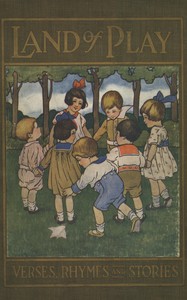
The title page credits illustrators Maria Louise Kirk and Florence England Nosworthy, both active in early 20th-century children’s book illustration. While the excerpts do not include images, the presence of two illustrators suggests a visually rich volume. Kirk was known for her delicate, romantic style, often depicting children and fairy-tale scenes; Nosworthy contributed to numerous juvenile books. The text’s layout—with poems and rhymes separated by white space—implies that illustrations likely accompanied each piece. The catalog’s omission of illustration as a subject is notable, given the prominence of visual art in the book’s production. Readers may wish to consult the original 1911 edition to assess how the artwork interacts with the text.
The excerpts reveal a collection that is more varied than its catalog subjects suggest. Readers interested in early 20th-century children’s anthologies will find a blend of folk rhymes and literary works, shaped by a compiler who valued both tradition and contemporary authors. The book’s structure—short pieces, frequent rhyme, and a playful tone—makes it suitable for reading aloud. For a fuller understanding, compare the selections here with those in other anthologies of the period, such as The Golden Book of Poetry or St. Nicholas Magazine.
There’s a particular hush in Land of Play, as if the verses still echo from a porch swing at dusk. I find myself returning to that feeling often, especially when thinking of Kate Greenaway’s lost hare—that gentle, wandering melancholy. It’s the same quiet ache, the same remembered sunshine, caught in Ballad of the Lost Hare — Inside the Classic. Strange how old rhymes hold our own childhoods so tenderly.
There are no reviews for this eBook.
There are no comments for this eBook.
Reader reflection
Record your reading impressions
A brief reflection can help important ideas stay with you longer.
Your progress
0
/
10
2
What was your overall reaction to the book?
3
Would you pass this book on to a friend?
4
What was the reading difficulty like?
5
How would you describe its reading pace?
6
How well did it match your expectations?
7
Did the book offer a fresh perspective?
8
Could you apply anything you learned?
9
What changed or sharpened your thinking?
10