1

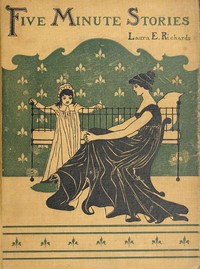
Five Minute Stories — Background and Themes
(0 User reviews)
291
Project Gutenberg
2015
Not confirmed
Children's poetry; Children's stories; Conduct of life -- Juvenile literature; Children -- Conduct of life -- Juvenile literature
Readers of public-domain and historical texts
Project Gutenberg digital edition
en
Edition facts
Words
49,362
Reading time
215 min
Text sections
105
This digital edition of Five Minute Stories — Background and Themes is described by source-level measurements including 49,362 words, 3 hr 35 min estimated reading time, and 105 detected text sections.
The text analysis averages about 15.3 words per sentence, while the detected sections provide another way to judge how the source is divided.
Project Gutenberg metadata also associates the work with “Children's poetry,” connecting these edition facts with the source record’s subject description.
Source:
Project Gutenberg record #49748
This collection of short stories and poems by Laura E. Richards uses simple language and moral lessons to entertain children. The excerpts show a focus on kindness, resourcefulness, and imaginative play, with recurring motifs of generosity and problem-solving.
Read the complete public-domain text at its original source.
Read on Project GutenbergThe excerpts from Five Minute Stories reveal a collection that often centers on children navigating small dilemmas with ingenuity and goodwill. In 'A Long Afternoon,' Will's boredom is transformed through helping his aunt and playing with his baby brother, turning a rainy day into an adventure. The story 'Jack's Christmas' shows a boy misunderstanding a bank's purpose, yet his desire to help a poor family leads to a generous outcome. These tales, written in straightforward prose with occasional dialect, emphasize practical kindness over abstract moralizing.
Moral Lessons Through Everyday Situations
The catalog subjects list 'Conduct of life -- Juvenile literature' and 'Children -- Conduct of life,' and the excerpts bear this out, but the lessons are embedded in concrete scenarios rather than explicit instruction. In 'Jack's Christmas,' the boy's plan to 'buy money' for a poor woman is gently corrected by three gentlemen who instead guide him to give his own toys and receive gold coins for a turkey, mince-pies, and plum-pudding. The moral—that generosity is more valuable than wealth—emerges from the plot, not a lecture. Similarly, 'A Long Afternoon' does not scold Will for his boredom; instead, Aunt Harriet and his mother offer tasks that lead to storytelling and imaginative play, implicitly teaching that helping others and using one's imagination can alleviate restlessness.
Voice and Characterization in Dialogue
Richards uses distinctive speech patterns to characterize her young protagonists. Jack's dialogue includes grammatical errors like 'I comed' and 'I fought,' marking his youth and unschooled sincerity. The gentlemen speak in a more formal, kindly register, addressing him as 'dear' and 'my dear little boy.' In 'A Long Afternoon,' Will's complaint—'What shall I do all this long afternoon?'—is echoed by Aunt Harriet's sympathetic 'Poor lad!' before she gives him a task. The baby's participation is described through sound effects ('blew a tin whistle') rather than dialogue, emphasizing the physicality of play. These vocal contrasts create distinct personalities without lengthy description.
Recurring Motifs: Generosity and Imaginative Play
Two motifs recur across the excerpts: generosity and imaginative play. In 'Jack's Christmas,' the boy's initial plan to buy money for a poor woman is replaced by direct gift-giving, and the three gentlemen's contributions of gold pieces for specific foods underscore a communal, festive generosity. In 'A Long Afternoon,' Will's imaginative game—pretending a woolly ball is a tiger and he and baby are elephants—transforms a dreary day. The story explicitly references the 'Swiss Family Robinson' as inspiration for the elephant trumpeting, grounding the fantasy in familiar literature. Both stories resolve with emotional warmth: Jack receives kisses, and Will stops trumpeting to avoid tiring his mother, showing consideration. These motifs align with the catalog's 'Conduct of life' subject but are rendered through action, not precept.
Readers approaching Five Minute Stories should expect short, self-contained narratives that reward attention to dialogue and detail. The excerpts suggest that Richards often builds stories around a single, simple misunderstanding or a moment of boredom, then resolves it through kindness or creativity. The collection's title hints at its utility for brief reading sessions, and the stories' moral weight is carried by plot and character rather than overt instruction. Those interested in early 20th-century children's literature will find a consistent voice and a gentle, optimistic worldview.
There’s something tender in these little stories, how a child’s scraped knee becomes a lesson in grace. I found myself thinking of that quiet generosity when I later opened The World's Best Poetry, Volume 04: The Higher Life — Background and Themes, and there it was again—that same soft nudge toward the better self, waiting between the lines.
There are no reviews for this eBook.
There are no comments for this eBook.
Reader reflection
What was your reading experience?
Capture what you thought, learned, and would like to remember.
Your progress
0
/
10
2
Was reading this book enjoyable?
3
How likely are you to recommend this book?
4
What was the reading difficulty like?
5
Would you read this book again?
6
How strongly did the book affect you emotionally?
7
How original did the book feel?
8
Did you relate to its people, ideas, or situations?
9
What changed or sharpened your thinking?
10