1

Elfin Land — Reading Companion
(0 User reviews)
1708
Project Gutenberg
2023
Not confirmed
Children's poetry, American; Animals -- Juvenile poetry; Conduct of life -- Juvenile poetry; Children -- Conduct of life -- Juvenile poetry; Elves -- Juvenile poetry
Readers of public-domain and historical texts
Project Gutenberg digital edition
en
Edition facts
Words
5,419
Reading time
24 min
Text sections
26
This digital edition of Elfin Land — Reading Companion is described by source-level measurements including 5,419 words, 24 min estimated reading time, and 26 detected text sections.
The text analysis averages about 19.6 words per sentence, while the detected sections provide another way to judge how the source is divided.
Project Gutenberg metadata also associates the work with “Children's poetry, American,” connecting these edition facts with the source record’s subject description.
Source:
Project Gutenberg record #70491
Josephine Pollard’s 1882 children’s poetry collection uses a fixed stanza structure and recurring images of dancing, moonlight, and sea creatures to create a playful, orderly fantasy world. Observations focus on the verse form, the repeated motif of the man in the moon, and the movement between domestic and natural scenes.
Read the complete public-domain text at its original source.
Read on Project GutenbergJosephine Pollard’s Elfin Land (1882) opens with a “Greeting” that invites readers to “Take a stroll through Elfin-Land,” establishing the book as a guided tour through a whimsical realm. The collection comprises 26 short poems, each occupying a single page or spread, and the contents list reveals a structure that alternates between human-like characters (such as “The Man in the Moon” and “A Very Handsome Mermaid”) and animal subjects (like “The Peacock’s Train” and “The Bee’s Mistake”). This alternation creates a rhythm of shifting perspectives, moving from celestial to terrestrial, from sea to shore.
Fixed Stanzas and Rhythmic Consistency
Every poem in Elfin Land is written in regular quatrains with an ABAB or AABB rhyme scheme, typically in iambic tetrameter or trimeter. For instance, “The Man in the Moon” uses couplets: “The man in the moon once had a wife, / And she was really the plague of his life.” This metrical uniformity gives the collection a sing-song quality suitable for reading aloud. The consistency also means that variation—such as the occasional longer line or a shift in stanza length—stands out. In “The Dance on the Beach,” the starfish’s dance is described in a series of couplets that mimic the “twinkling feet” of the dancers, reinforcing the connection between poetic form and subject matter.
The Man in the Moon as a Recurring Figure
The man in the moon appears in at least two poems: his own titled piece and “The Dance on the Beach.” In the former, he is a rough character whose wife falls from their canoe and becomes a mermaid-like figure sailing alone. In the latter, he “from his binnacle soon / Suspended the beacon-light,” allowing a starfish to dance in the moonlight. This recurrence suggests a loose narrative thread or at least a shared cosmology. The moon figure is not a single consistent character—he is both a husband and a lighthouse keeper—but his presence across poems ties the collection together. The moon itself becomes a stage light for the creatures below, a motif that Pollard returns to in other poems such as “The Moon has a Host of Children.”
Movement Between Domestic and Natural Scenes
Pollard’s poems frequently shift between indoor, domestic settings and outdoor, natural ones. “The Grimalkin Family” likely involves cats (a domestic animal), while “The Dance on the Beach” takes place on a sandy shore. “A Garden Party for Three” suggests a social event in a garden, blending human social rituals with the natural world. This movement is not random; it mirrors the structure of the contents list, which intersperses poems about fairies and elves with those about animals and natural phenomena. The effect is a world where the boundaries between home and wilderness are porous, and where creatures from different realms can interact—as when the starfish dances to the “seaside band” under the moon’s light.
Illustrations and the Role of the Visual
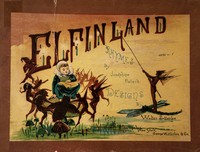
Walter Satterlee’s illustrations are integral to the book’s design, as indicated by the original publication by George W. Harlan & Co. in 1882. The poems are short enough to be accompanied by full-page or half-page engravings, and the text often describes visual details that would have been depicted in the artwork. For example, “The Peacock’s Train” describes the bird’s plumage as “sparkling gem” and “shining eyes,” inviting the reader to imagine the illustration. The interplay between text and image is crucial: the poems do not merely describe scenes but seem to caption or narrate the pictures. This reliance on visual accompaniment means that the digital edition, which may lack the original illustrations, requires the reader to supply the imagery from the verbal descriptions.
Because the excerpts are incomplete, it is unclear whether the poems form a continuous narrative or remain independent vignettes. Readers may wish to pay attention to how the man in the moon and other recurring elements (such as the sea and the moon) connect the poems. The fixed stanza structure makes the collection ideal for reading aloud, and the shifts between domestic and natural scenes invite comparisons between human and animal behavior. Without the original illustrations, the verbal imagery becomes the primary vehicle for the fantasy world.
Years among these shelves taught me how Elfin Land builds its little lantern-lit world through repeated moonbeams and gentle dance steps. There is a similar, softer strangeness in The Madman: His Parables and Poems — A Closer Reading, where the moon keeps its own counsel, and order bends the way water does. Both whisper rather than shout.
There are no reviews for this eBook.
There are no comments for this eBook.
Reader reflection
Take a moment to reflect on this book
Create a short personal record of your experience with this book.
Your progress
0
/
10
2
Did this book hold your interest?
3
Is this a title you would suggest to others?
4
How demanding did the text feel?
5
Did the book give you something worth debating?
6
How would you rate its originality?
7
Was the book easy to understand?
8
What was the strongest part of the book?
9
Which lesson or insight stayed with you?
10